

B 179 - Major wildfire on the K 43 between Börrstadt and Sippersfeld
| Incident Number: | B 179 |
| Date: | 30.07.2026 |
| Alarm time: | 13:23 |
| End of operation: | 18:00 |
| Incident keyword: | Large wildfire |
Report
On Thursday afternoon, the Winnweiler, Steinbach, Breunigweiler, and Sippersfeld fire departments were initially dispatched to a call classified as a “small wildfire” on the K 43 between Sippersfeld and Börrstadt. Even as the first vehicles were en route, the dispatch center reported that several emergency calls had since been received. The smoke was also already visible from the L 401 near Alsenbrück-Langmeil. As a result, the Börrstadt Fire Department was initially called in as backup, and shortly thereafter, the alert level was raised to “large wildfire.”
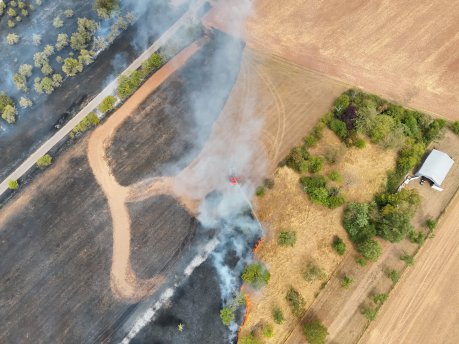
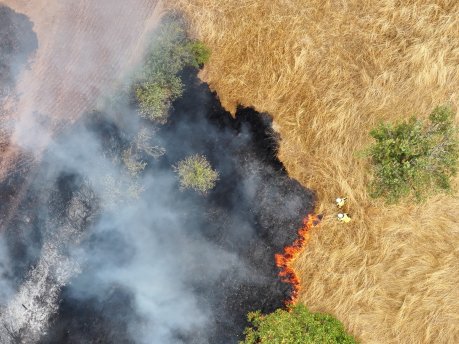
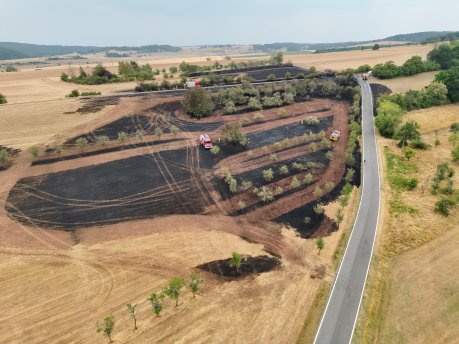
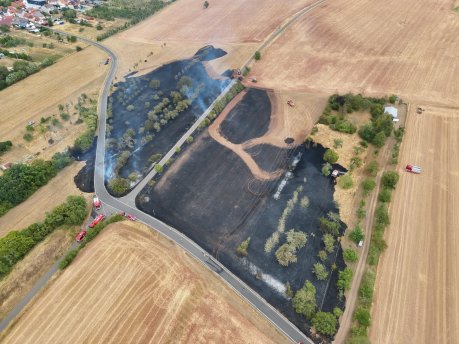
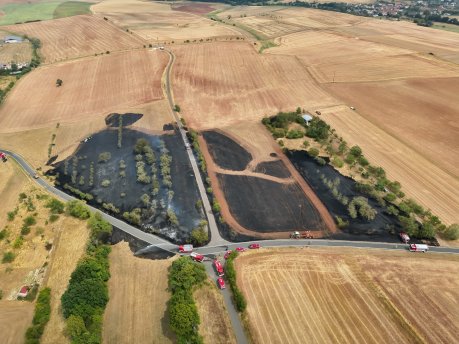
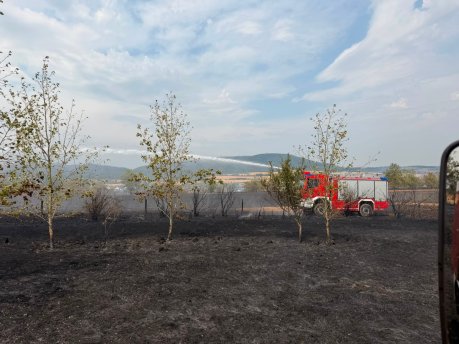
A meadow area with fruit trees was on fire at the scene, and the fire spread rapidly in various directions, even spreading to adjacent stubble fields. Due to the prevailing wind and the resulting flying sparks, several so-called “spot fires” broke out in various locations, causing the fire to even jump across the road in one area. In the initial phase, there was a massive amount of smoke, which, driven by the wind, spread to the first residential buildings in Börrstadt within a very short time.
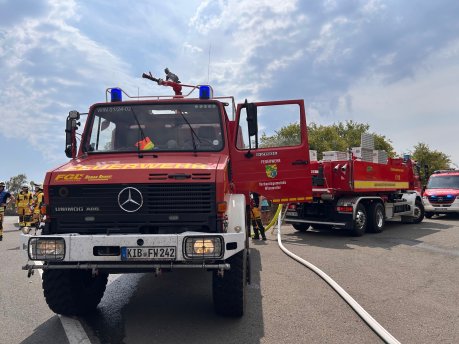
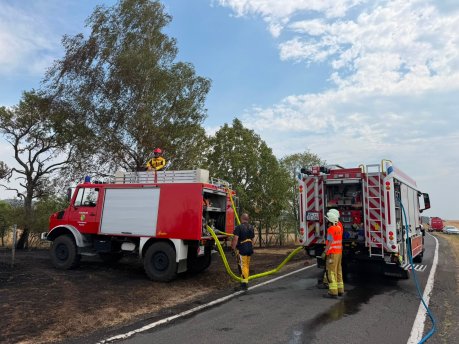
The numerous fire trucks dispatched from the Winnweiler municipal association, as well as the fire departments of Göllheim and Enkenbach, fought the flames using the “pump and roll” method in an effort to stop the fire from spreading. At the same time, numerous ground crews equipped with backpack fire extinguishers and fire beaters were also on the scene. After about half an hour, the fire was initially brought under control; however, the wind repeatedly caused it to flare up again, making the mop-up operations extremely difficult and extensive.
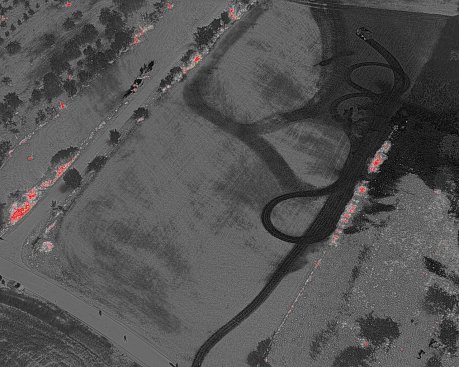
The drone unit provided the incident command with an aerial overview of the situation, allowing the tanker trucks to be effectively coordinated to immediately extinguish any pockets of fire that flared up again. The thermal imaging camera once again proved extremely helpful, as it allowed for the early detection of areas that were still at very high temperatures underground. The numerous fruit trees posed a particular challenge, as the fire had worked its way into the interior of the trunks in a very short time due to the dry conditions. To extinguish the fire deep within the trunks, some trees therefore had to be felled and chopped up using a chainsaw. While the firefighting efforts were underway, a farmer assisted by using a rotary tiller to work the edges of the burned area, thereby completely preventing any further spread.
During the operation, the incident scene was divided into four sections. Operational Section (EA) 1 handled firefighting using ground crews and a fire engine (TLF) in “pump and roll” mode in the area toward Börrstadt. Section 2 was responsible for firefighting in the affected area toward Sippersfeld. Logistics and supplies for the emergency personnel—particularly ensuring an adequate supply of beverages—were handled by Section 3. The fourth section was the “Safety Section,” which initially monitored the potential spread of the fire in relation to weather conditions and was later responsible for assessing and felling the trees.
The total affected area was estimated at 2.3 hectares. Approximately 60 emergency responders with 17 vehicles were on the scene. The standby ambulance from the Münchweiler branch of the German Red Cross (DRK) was on site to ensure the safety of the emergency responders, and the police were also present at the scene with one vehicle. The Fire and Disaster Protection Inspector (BKI) for the Donnersberg district and his deputy were on site in an advisory capacity and assisted the incident command. The Situation Center of the Rhineland-Palatinate State Office for Fire and Disaster Protection (LfBK) was kept informed of the situation by the BKI as the operation unfolded.
 |  |  |
 |  |  |
 |  |  |