

Risk of Forest and Wildfires
Current Wildfire Risk
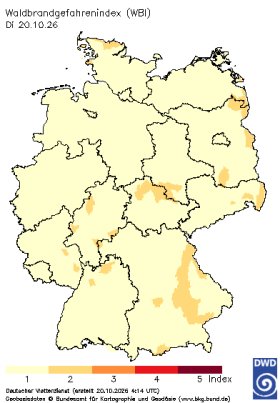
Wildfire Danger Index (WBI)
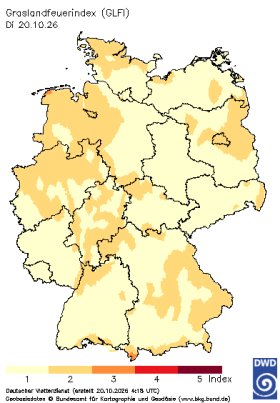
Grassland Fire Index (GLFI)
General Information
A forest fire is a type of vegetation fire and goes through approximately three stages as it spreads. Initially, it is visible only as a ground fire, but in the second stage, it can quickly jump to the treetops. Once this happens, it is referred to as a crown fire. Unlike a ground fire, a crown fire is much more difficult to fight, as this type of fire is capable of spreading extremely quickly. There is therefore not much distance between phase two and the final stage—a total fire. In our region, given the climatic conditions of Central Europe, this full-scale fire can be prevented by extinguishing the underlying ground fire, since there is sufficient moisture here.
Of course, grass and forest fires are caused by various factors. On the one hand, natural phenomena, such as a lightning strike, can be responsible for a fire breaking out; however, much more frequently, initial ground fires in the forest are caused by negligent forest visitors, who are to blame for the fire starting in the forest. That is why there are various precautions that every citizen should follow when spending time in the woods.
- Never carelessly throw away cigarette butts (not even from a car)
- Do not light open fires or campfires in the forest or in meadows
- Never park cars or other vehicles on highly flammable surfaces
- Avoid litter (e.g., glass bottles, lighters, plastic wrap)
- Keep dirt roads and forest entrances clear
Visitors to the forest should keep these points in mind, especially during dry periods in the summer, as they are part of the preventive measures against forest fires. While it is highly unlikely, for example, that glass bottles would concentrate the sun’s rays and thereby ignite leaves or other grasses, the situation becomes much more dangerous once they are filled with water. In such cases, even PET bottles can ignite vegetation. But what should you do if you do happen to spot a wildfire? If a passerby witnesses a fire, they should report it immediately by calling the emergency number 112.
However, you should never attempt to extinguish a fire on your own.
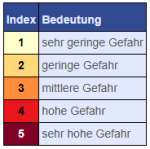
Fortunately, Rhineland-Palatinate experiences relatively few wildfires compared to other federal states in Germany. Overall, however, the number of wildfires per year is increasing at a relatively rapid rate, which is linked, among other factors, to climate change. The fact that the climate in Germany is becoming increasingly warmer and drier further contributes to these forest fires. To provide a regional assessment of the current forest fire risk, the Forest Fire Risk Index is used. This index describes the risk to forests posed by weather conditions and is based on meteorological data for a selected region. To calculate it, values such as air temperature, relative humidity, precipitation rate, radiation levels, and wind speed are required, allowing for a forecast to be made for the following four days . The index comprises a total of five risk levels.
The Grassland Fire Index (GLFI), on the other hand, describes the risk of grassland fires. This refers to the fire risk in open, unshaded areas with a layer of dead wild grass and no green undergrowth, and is calculated using similar values.