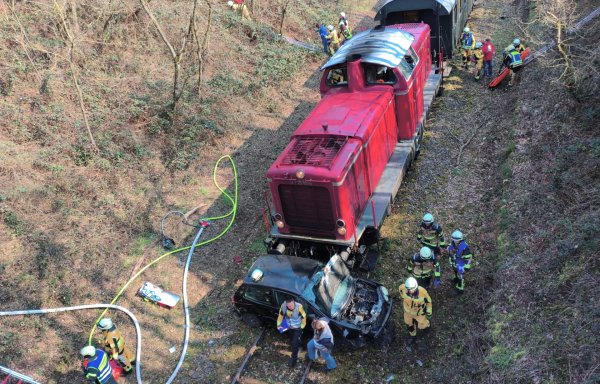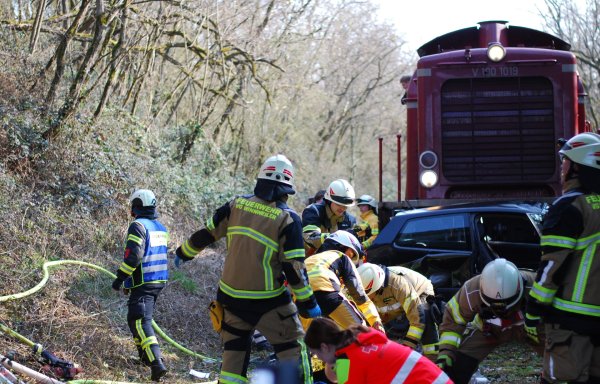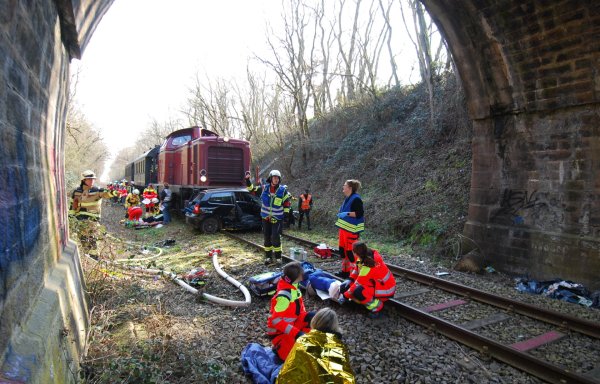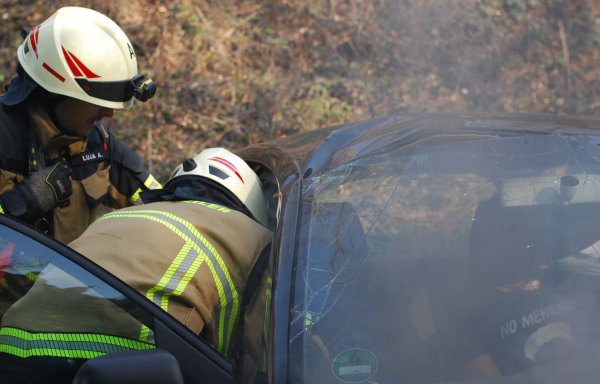

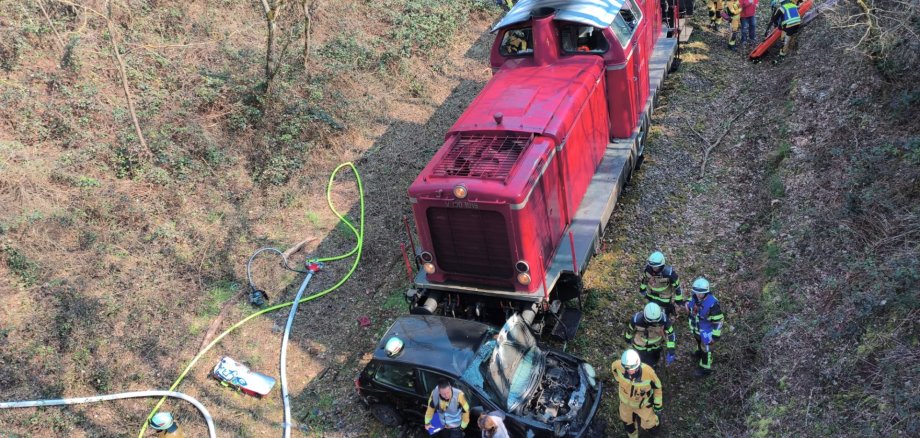
The closure of the rail line was confirmed to emergency responders while they were still en route, allowing them to proceed directly to the scene of the accident. Upon arrival, the first responders from the Börrstadt Fire Department found a passenger train consisting of two cars that had collided with a small car. Shortly thereafter, smoke was seen coming from the car, which developed into a small fire. Since there were still three people inside the vehicle at that time, the incident commander from the Winnweiler Fire Department, who had arrived in the meantime, decided to prioritize the immediate rescue of the occupants and then proceed with firefighting. After a further assessment of the situation and the initial evaluation by the first emergency medical technician to arrive, the alert level was raised to 4, as an estimated 30 patients—some with severe or even life-threatening injuries—had to be rescued from the train, transported to the patient triage area, and treated. The terrain posed a particular challenge, as the railroad track is bordered on both sides by a slope that had to be traversed. Consequently, the increase in the alert level led to the additional mobilization of numerous fire and rescue personnel from the Donnersberg district. In particular, due to the geographical location, units from the Göllheim municipal fire department were also present.
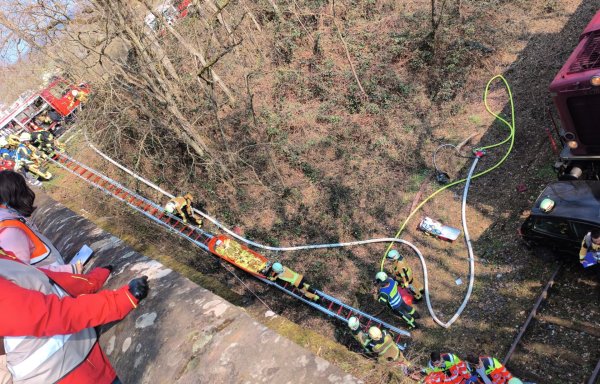
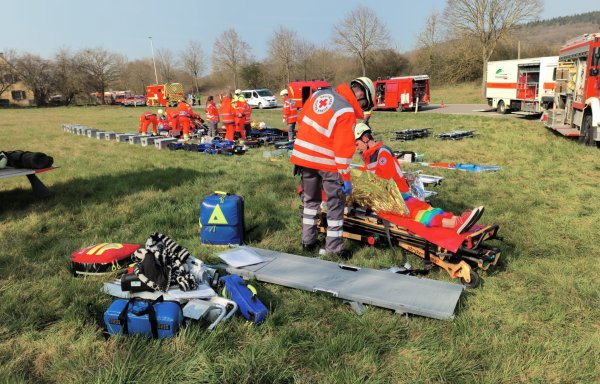
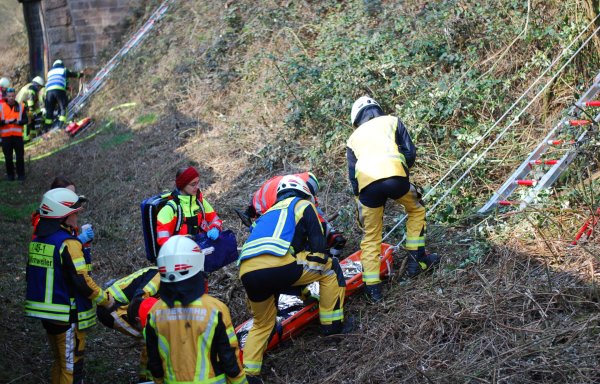
As the exercise progressed, the incident site was divided into a total of four sections to ensure a structured approach to the scenario. Operational Section (OS) 1 was “Technical Train Rescue,” OS 2 handled “Track Logistics,” and OS 3 covered “Road Logistics.” The fourth section was “Healthcare,” to which all medical personnel were assigned. A patient triage area was quickly set up above the incident site, to which the injured were gradually transported. Triage was conducted inside the train to categorize patients according to the severity of their injuries and thus prioritize rescue efforts so that those with life-threatening injuries could be treated first. Firefighters used sections of extension ladders to set up three hoists, via which patients could be pulled upward on stretchers. Thanks to the structured and swift cooperation of all those involved, approximately 90 minutes after the first responders arrived, all affected individuals had been medically assessed, freed from the train, received first aid at the triage area, and, in some cases, already transported away. Since there were also some uninjured people on the train, arrangements were made in the meantime to open the nearby Börrstadt village community hall as a care center.
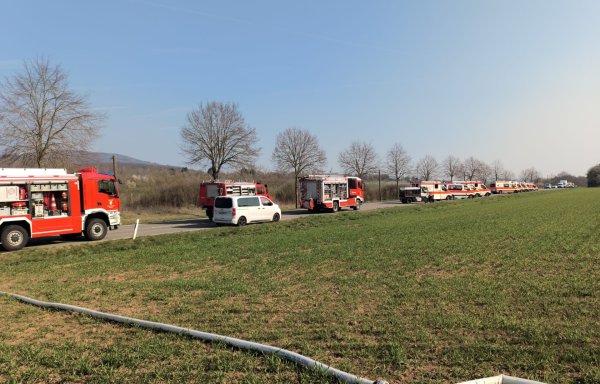
For the duration of the drill, the L 401 between Langmeil and the Hahnweilerhof was completely closed, similar to what would happen during an actual emergency in this area, as this area serves as a staging area for emergency vehicles, as well as an access and exit route for rescue vehicles and a landing site for rescue helicopters. In addition to the units already mentioned, the Rapid Response Catering Group (SEG-V) was also alerted during the exercise; this group is also called upon during actual incidents of this scale to provide emergency personnel with beverages and snacks, as well as a hot meal if necessary. Here, too, the exercise was used to practice procedures and workflows by setting up a supply station at the Winnweiler Fire Department, where all participants were provided with food and drinks following the exercise. In addition to the fire department and emergency medical services units, the Kaiserslautern Integrated Control Center (ILS) and the Westpfalz Clinic also utilized the exercise scenario to practice related internal procedures behind the scenes. The exercise was observed by several observers, including a representative from the State Office for Fire and Disaster Protection (LfBK) who was on site.
We would like to take this opportunity to thank all emergency responders, exercise observers, and actors playing the roles of injured persons, as well as the organizers responsible, for their respective contributions, which led to the exercise’s ultimate success. Since operations of this magnitude are relatively rare, exercises like this are all the more important for preparing the emergency responders involved so that they can rely on established procedures in the event of an actual emergency.